AIM is a rare, chronic, progressive disease with muscular and extramuscular manifestations that can lead to a loss of independence and quality of life2,3
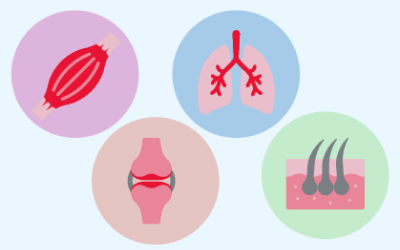
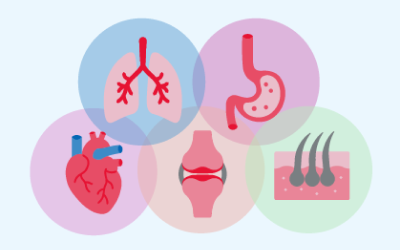
Progressive skeletal muscle weakness remains the hallmark manifestation, most commonly affecting proximal muscle groups. Extramuscular disease is also common and may involve multiple organ systems, including:1
Pulmonary manifestations
Particularly interstitial lung disease (ILD)1,4
Cutaneous
(rashes/calcinosis/itch)1,5
Cardiac
(myocarditis/cardiomyopathy)1,6
Gastrointestinal
(dysphagia)1
Manifestations such as interstitial lung disease, dysphagia and myocarditis are of particular clinical concern due to their impact on morbidity and mortality.7
AIM is comprised of distinct subtypes with diverse presentations
AIM includes several recognized subtypes, classified based on clinical, serological, and pathological features.

Dermatomyositis (DM)
Antisynthetase syndrome (ASyS)

Immune-mediated necrotizing myopathy (IMNM)

Inclusion body myositis (IBM)a
Overlap myositis (OM)

Polymyositis (PM)b
Differentiating AIM subtypes
The major subtypes of AIM are defined by combinations of clinical manifestations, histopathological findings, imaging features, and autoantibody profiles. Increasing recognition of myositis-specific autoantibodies has refined disease classification and improved understanding of subtype-specific phenotypes.5,8
While overlap exists between subtypes, each demonstrates characteristic patterns of muscle involvement and extramuscular disease.5,8
Clinical Manifestations:
Symmetric proximal muscle weakness, prominent muscle atrophy
Systemic Manifestations:
Malignancy, connective tissue diseases
Autoantibodies:
SRP (severe, progressive weakness); HMGCR (associated with statin exposure)
Clinical Manifestations:
Symmetric proximal muscle weakness, and presence of at least one of the associated conditions
Systemic Manifestations:
ILD, mechanic’s hands, arthritis, Raynaud’s syndrome
Autoantibodies:
Jo1, PL7, PL12, EJ, OJ, KS, ZO, YRS/HA
Clinical Manifestations:
Symmetric proximal muscle weakness
Systemic Manifestations:
ILD, malignancy, myocarditis
Autoantibodies:
Seronegative for myositis-specific autoantibodies
Clinical Manifestations:
Symmetric proximal muscle weakness co-exists with features of other autoimmune diseases
Systemic Manifestations:
Scleroderma, systemic lupus erythematosus
Autoantibodies:
PMScl, Ro52, Ku, U1RNP
Clinical Manifestations:
Proximal as well as distal muscle weakness that is often asymmetric; facial muscles may be involved
Systemic Manifestations:
Dysphagia
Autoantibodies:
cN1A
Continue exploring AIM
Learn more about AIM.
What is AIM?
AIM is a chronic, progressive autoimmune rheumatic disease comprised of distinct subtypes.1
a The pathogenesis of IBM is debated. While it can be categorized as an idiopathic inflammatory myopathy, it may not fit completely under the term 'autoimmune myositis.'9
b Polymyositis is increasingly considered a diagnosis of exclusion, as many cases are reclassified into more specific subtypes with advancing diagnostic criteria.2
c Cutaneous features include heliotrope, shawl sign, Gottron’s papules, etc.
Abbreviations:
AIM, autoimmune myositis; ASyS, antisynthetase syndrome; CCAR-1, cell cycle and apoptosis regulator 1; CN1a, cytosolic 5’-nucleotodase 1A; DM, dermatomyositis; EJ, glycyl-tRNA synthetase; HMGCR, 3-hydroxy-3-methylglutaryl-CoA reductase; IBM, inclusion body myositis; ILD, interstitial lung disease; IMNM, immune-mediated necrotzing myopathy; KS, asparaginyl-tRNA synthetase; MDA5, melanoma differentiation-associated gene 5; NXP2, nuclear matrix protein 2; OJ, isoleucyl-tRNA synthetase; OM, overlap myositis; PL7, threonyl-tRNA-synthetase; PL12, alanyl-tRNA synthetase; PM, polymyositis; PMScl, polymyositis–scleroderma overlap; SAE, small ubiquitin-like modified activating enzyme; Sp4, transcription factor Sp4; SRP, signal recognition particle; TIF1γ, transcription intermediary factor 1-gamma; U1RNP, U1 small nuclear ribonucleoprotein; ZO, phenylalanyl-tRNA synthetase.
References:
1. Diomedi M, et al. Clin Exp Rheumatol. 2026;44(2):167–177; 2. Lundberg IE, et al. Nat Rev Dis Primers. 2021;7(1):86; 3. Oldroyd A, et al. BMC Rheumatol. 2020;4:47; 4. Saketkoo LA, et al. Curr Rheumatol Rev. 2010;6(2):108–119; 5. Oldroyd A, et al. Clin Med (Lond). 2017;17(4):322–328; 6. Zhu H, et al. J Inflamm Res. 2025:18:3879–3888; 7. Khoo T, et al. Nat Rev Rheumatol. 2023;19(11):695–712; 8. Paik JJ, et al. Rheumatology. 2025;64:3288–3302; 9. Greenberg SA. Nat Rev Rheumatol. 2019;15(5):257–72.